

LEGO and the World Cup: What We Know So Far About LEGO’s Upcoming FIFA Sets|Mark's Magic
LEGO’s relationship with football is entering a new phase.
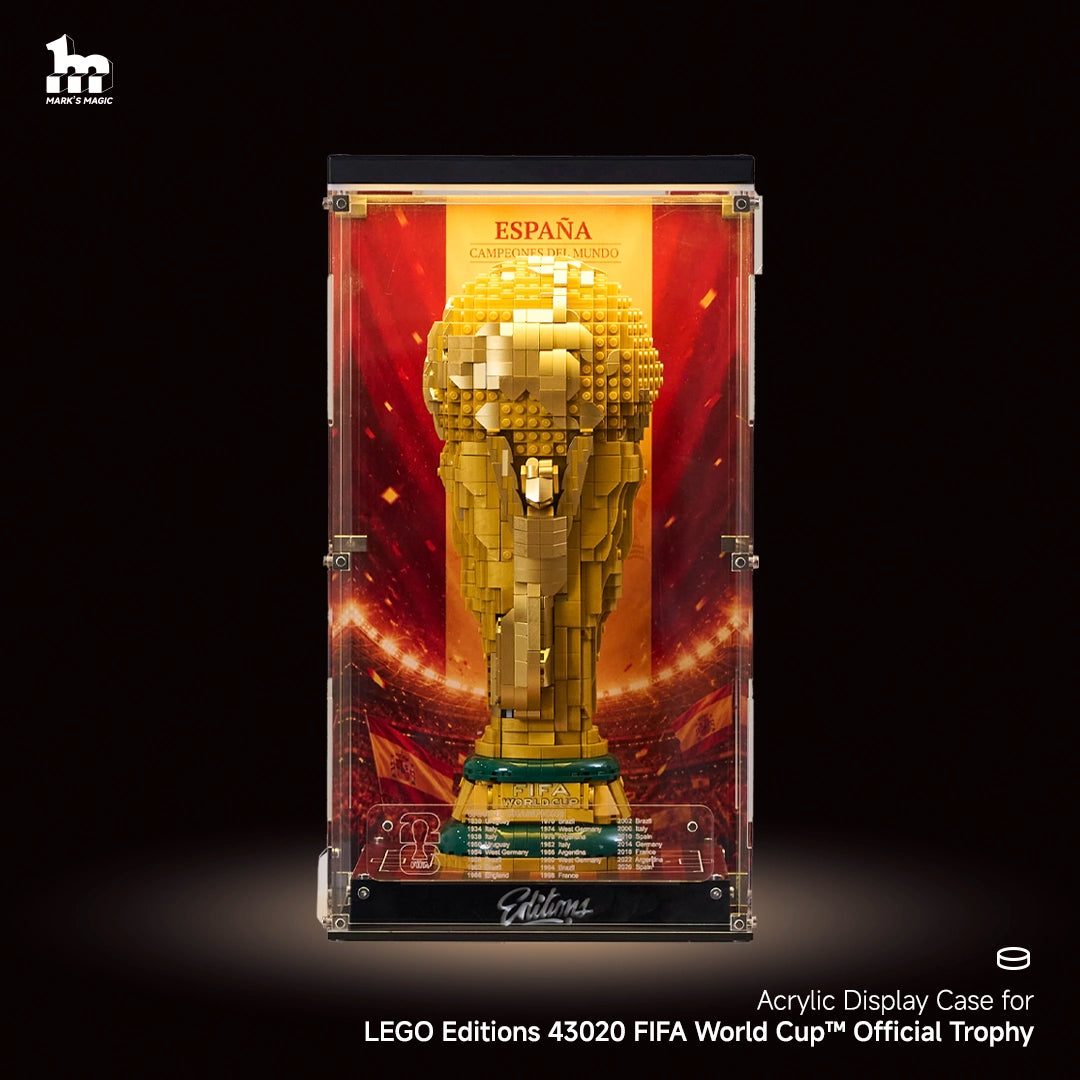
With the official reveal of the LEGO 43020 FIFA World Cup Official Trophy, LEGO has confirmed not only a renewed partnership with FIFA, but also the launch of an entirely new direction under the LEGO Editions banner. This isn’t just another licensed set—it’s a statement about how LEGO wants to approach global sports culture heading into the 2026 FIFA World Cup.
So what makes this release different, and why does it matter?

LEGO Editions: A Shift in Philosophy
According to recent coverage, the FIFA World Cup Trophy set is positioned as part of LEGO’s newly introduced LEGO Editions theme. Rather than focusing on play scenarios, LEGO Editions appears to center on iconic, symbolic objects—items that carry historical, cultural, and emotional weight.
Instead of recreating football matches, teams, or stadium scenes, LEGO Editions leans toward something closer to collectible design pieces. These are models meant to be built once, displayed long-term, and appreciated as representations of something larger than the bricks themselves.
From that perspective, choosing the World Cup Trophy as the first major football-related release makes perfect sense.
Why the Trophy, Not the Game?
The World Cup Trophy is arguably the most universally recognized symbol in football. It transcends teams, nations, and even individual tournaments. By focusing on the trophy rather than gameplay, LEGO avoids the complexity of team licenses, player likenesses, and rapidly aging sports moments.

More importantly, the trophy represents achievement, legacy, and shared memory—values that align closely with LEGO’s recent move toward adult-oriented, display-first sets. Much like architectural landmarks or historic spacecraft, the trophy functions as a cultural artifact rather than a toy.
This design choice signals that LEGO is less interested in simulating football—and more interested in honoring what football means.

A Display-First Build with Narrative Depth
At over 2,800 pieces, the FIFA World Cup Trophy set is clearly designed for adult builders. The focus is on form, texture, and presence, resulting in a model that feels closer to a sculptural object than a playset.
One of the most thoughtful details is hidden inside the build itself.
The top section of the trophy can be opened to reveal a small interior scene—subtle, restrained, and intentionally concealed. Rather than interrupting the clean exterior, this hidden feature adds narrative depth without compromising the display-focused nature of the model.

The World Cup Ball Set: Completing the Symbolic Trio
Alongside the World Cup Trophy, LEGO has also introduced a brick-built World Cup football set, further clarifying the direction of the LEGO Editions theme.

Just like the trophy, the football is not presented as a toy or a playable object. Instead, it functions as a pure symbol of the sport itself—arguably even more universal than the trophy. No teams, no players, no action scenes. Just the object that connects every match, every goal, and every moment of the World Cup.


The decision to create a fully brick-built football reinforces LEGO’s display-first philosophy. While a sphere is one of the most technically challenging shapes to recreate with bricks, LEGO leans into that challenge rather than avoiding it. The result is not about perfect realism, but about interpretation—how far bricks can go in representing a globally recognized form.

Much like the trophy, the football set is designed to be built once and displayed long-term. It doesn’t rely on minifigures or interactive play features to justify its existence. Its value lies in recognition and symbolism, not action.
When viewed together—the Trophy, the Football, and the distributed minifigures across the series—a clear pattern emerges. LEGO is not trying to recreate the World Cup as an event. Instead, it is distilling the World Cup into its core icons:
the prize, the game, and the people behind it.
This trio approach further confirms that LEGO Editions is less about play and more about cultural representation through design.
The Role of the Football Minifigures: Symbol, Not Play
Rather than concentrating all attention on a single player, LEGO has chosen to distribute four football minifigures across four different World Cup–related sets. This is a deliberate and telling design decision.

In the FIFA World Cup Trophy set, the minifigure is hidden inside the trophy itself—not placed front and center. Unlike traditional LEGO sports sets where minifigures exist to drive gameplay, these figures are not meant to recreate matches or form teams. Instead, each minifigure functions as a symbolic element, representing the human effort and collective achievement behind the World Cup.
By spreading the players across multiple sets, LEGO avoids turning any single product into a character-driven playset. No one player dominates the narrative. The focus remains on the idea of victory, legacy, and shared achievement, rather than individual action.
Placing the minifigure inside the trophy further reinforces this philosophy. The player becomes part of the story behind the object, not the visual centerpiece of the display. It’s a subtle reminder that while the trophy is iconic, it only exists because of the players who earn it.
Within the context of LEGO Editions, this approach feels intentional. The minifigures add emotional context and narrative depth, while allowing each set to remain firmly rooted in a display-first, symbolic identity—not traditional play.
What This Means for LEGO’s Football Future
The FIFA World Cup Trophy set suggests that LEGO’s approach to football may move in a very different direction from the past. Rather than playsets and minifigure-driven action, we may see more icon-focused, display-oriented models tied to football culture.

Balls, emblems, trophies, and abstract symbols feel far more likely than traditional match recreations—especially under the LEGO Editions banner.
If this is the direction LEGO chooses to pursue, football becomes less about play and more about identity, memory, and design.
Final Thoughts
LEGO’s FIFA World Cup Trophy is not about winning a match—it’s about what winning represents.
By launching this set under the LEGO Editions theme, LEGO signals a broader ambition: to treat global cultural icons with the same design seriousness it applies to architecture, art, and history.
As the 2026 World Cup approaches, this trophy feels less like a one-off release and more like the opening chapter of a new LEGO storytelling language—one built not just for play, but for lasting display.

YOU MAY WANT TO KNOW:
-
LEGO FORMULA 1 HELMETS RUMORED FOR 2026 – HERE’S WHAT WE KNOW SO FAR!|
- IS IT WORTH TO BUY THE LEGO 75419 UCS DEATH STAR? THE RECORD-BREAKING SET EVER

Written by MaZhiyuan







Leave a comment
This site is protected by hCaptcha and the hCaptcha Privacy Policy and Terms of Service apply.